

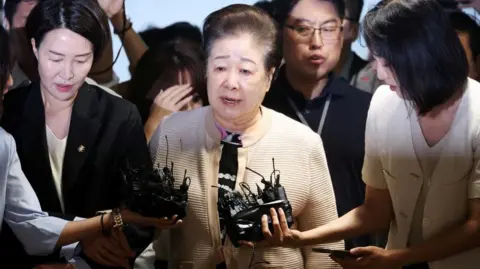
Han Hak-ja, figurehead of the controversial Unification Church, has firmly rejected claims that her organization provided high-end presents to South Korea's former president's wife in exchange for political privileges.
Facing reporters after an extended session of questioning at the prosecutor's office, she flatly rejected the allegations, remarking, "Absolutely not... Why would I engage in such acts?"
Ex- first lady Kim Keon Hee, spouse of former President Yoon Suk Yeol, is alleged to have accepting two designer handbags and a luxury jewelry item valued at £42,500.
Kim was formally charged recently on multiple charges, including bribery and securities fraud, all of which she denies.
Her arrest represented the first time in the country that both a former president and ex-first spouse have been jailed.
Yoon was taken into custody in January to face trial over a unsuccessful martial law bid last year that threw the country into chaos.
During questioning, Han attributed the incident to a former church official, claiming that the individual operated on his own when offering items to Kim. The official has since been taken into custody.
She appeared came after declining multiple requests from the investigative body. She stated, "I was in pain after heart operation."
An ambulance was made available during her questioning, according to sources.
Separately, officials arrested politician Kweon Seong-dong, who is alleged to have receiving a substantial sum in improper payments from the church. Kweon, once regarded as a trusted ally of Yoon, rejected the claim.
The religious organization, formally known as The Family Federation for World Peace and Unification, was founded in South Korea in the 1950s by Moon Sun-myung, who proclaimed himself the messiah.
It is best known for organizing large-scale marriage ceremonies with thousands of couples, many of which may have only just been paired by the institution.
Critics have labeled the organization as "cult-like". Lawyers have accused it of coercing followers, known as "Moonies" after its founder, to contribute significant amounts of money.
The group gained widespread scrutiny in Japan after the assassination of ex-Prime Minister Shinzo Abe. The accused individual blamed the organization for bankrupting his family and expressed resentment against Abe for allegedly supporting it.
It is prohibited in multiple countries, such as Singapore and Japan.


